TunOutScheduler Class Reference
#include <tunoutscheduler.h>
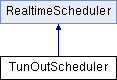
Inheritance diagram for TunOutScheduler:
Public Member Functions | |
| virtual | ~TunOutScheduler () |
 Public Member Functions inherited from RealtimeScheduler Public Member Functions inherited from RealtimeScheduler | |
| RealtimeScheduler () | |
| Constructor. | |
| virtual | ~RealtimeScheduler () |
| Destructor. | |
| virtual void | startRun () |
| Called at the beginning of a simulation run. | |
| virtual void | endRun () |
| Called at the end of a simulation run. | |
| virtual void | executionResumed () |
| Recalculates "base time" from current wall clock time. | |
| virtual void | setInterfaceModule (cModule *module, cMessage *notificationMsg, PacketBuffer *buffer, int mtu, bool isApp=false) |
| To be called from the module which wishes to receive data from the tun device. | |
| void | registerSocket (SOCKET fd, cModule *mod, cMessage *notifMsg, PacketBuffer *buffer, int mtu) |
| virtual cMessage * | getNextEvent () |
| Scheduler function – it comes from cScheduler interface. | |
| void | sendNotificationMsg (cMessage *msg, cModule *mod) |
| send notification msg to module | |
| virtual ssize_t | sendBytes (const char *buf, size_t numBytes, sockaddr *addr=0, socklen_t addrlen=0, bool isApp=false, SOCKET fd=INVALID_SOCKET) |
| Send data to network. | |
| void | closeAppSocket (SOCKET fd) |
| Close the application TCP socket. | |
| virtual SOCKET | getAppTunFd () |
| Returns the FD for the application TUN socket. | |
Protected Member Functions | |
| virtual int | initializeNetwork () |
| Initialize the network. | |
| virtual void | additionalFD () |
| This function is called from main loop if data is accessible from "additional_fd". | |
| Protected Member Functions inherited from RealtimeScheduler | |
| virtual bool | receiveWithTimeout (long usec) |
| Waits for incoming data on the tun device. | |
| virtual int | receiveUntil (const timeval &targetTime) |
| Tries to read data until the given time is up. | |
Protected Attributes | |
| char * | dev |
| Protected Attributes inherited from RealtimeScheduler | |
| std::map< SOCKET, SocketContext > | socketContextMap |
| fd_set | all_fds |
| SOCKET | maxfd |
| SOCKET | netw_fd |
| SOCKET | apptun_fd |
| cModule * | module |
| cMessage * | notificationMsg |
| PacketBuffer * | packetBuffer |
| size_t | buffersize |
| cModule * | appModule |
| cMessage * | appNotificationMsg |
| PacketBuffer * | appPacketBuffer |
| size_t | appBuffersize |
| int | appConnectionLimit |
| SOCKET | additional_fd |
| timeval | baseTime |
Detailed Description
Definition at line 37 of file tunoutscheduler.h.
Constructor & Destructor Documentation
|
virtual |
Definition at line 31 of file tunoutscheduler.cc.
{
if (additional_fd >= 0) {
#ifdef _WIN32
closesocket(additional_fd);
#else
close(additional_fd);
#endif
}
delete dev;
}
Member Function Documentation
|
protectedvirtual |
This function is called from main loop if data is accessible from "additional_fd".
This FD can be set in initializeNetwork by concrete implementations.
Reimplemented from RealtimeScheduler.
Definition at line 139 of file tunoutscheduler.cc.
{
sockaddr* from = (sockaddr*) new sockaddr_in;
socklen_t addrlen = sizeof(sockaddr_in);
SOCKET new_sock = accept( additional_fd, 0, 0 );
if (new_sock == INVALID_SOCKET) {
opp_warning("Error connecting to remote app");
return;
}
if (appConnectionLimit) {
int count = 0;
for (SOCKET fd = 0; fd < maxfd; fd++) {
if( FD_ISSET(fd, &all_fds)) count++;
}
if( count > appConnectionLimit ) {
// We already have too many connections to external applications
// "reject" connection
close(new_sock);
ev << "[UdpOutScheduler::additionalFD()]\n"
<< " Rejecting new app connection (FD: " << new_sock << ")"
<< endl;
return;
}
}
FD_SET(new_sock, &all_fds);
if( new_sock > maxfd ) maxfd = new_sock;
// Inform app about new connection
appPacketBuffer->push_back(PacketBufferEntry(0, 0, from, addrlen,
PacketBufferEntry::PACKET_FD_NEW, new_sock));
ev << "[UdpOutScheduler::additionalFD()]\n"
<< " Accepting new app connection (FD: " << new_sock << ")"
<< endl;
}
|
protectedvirtual |
Initialize the network.
Implements RealtimeScheduler.
Definition at line 45 of file tunoutscheduler.cc.
{
#if defined _WIN32 || defined __APPLE__
throw cRuntimeError("TunOutSchedulter::initializeNetwork():"
"TUN interface not supported on Windows/Max OS!");
return -1;
#else
// Initialize TUN device for network communication
// see /usr/src/linux/Documentation/network/tuntap.txt
struct ifreq ifr;
int err;
// get app port (0 if external app is not used)
int appPort = ev.getConfig()->getAsInt(CFGID_EXTERNALAPP_APP_PORT, 0);
// Initialize TCP socket for App communication if desired
if (appPort > 0) {
struct sockaddr_in server;
SOCKET sock;
// Waiting for a TCP connection
// WARNING: Will only accept exactly ONE app connecting to the socket
sock = socket( AF_INET, SOCK_STREAM, 0 );
if (sock == INVALID_SOCKET) {
opp_error("Error creating socket");
return -1;
}
int on = 1;
setsockopt(sock, SOL_SOCKET, SO_REUSEADDR, &on, sizeof(on));
memset( &server, 0, sizeof (server));
server.sin_family = AF_INET;
server.sin_addr.s_addr = htonl( INADDR_ANY );
server.sin_port = htons( appPort );
if (bind( sock, (struct sockaddr*)&server, sizeof( server)) < 0) {
opp_error("Error binding to app socket");
return -1;
}
if (listen( sock, 5 ) == -1 ) {
opp_error("Error listening on app socket");
return -1;
}
// Set additional_fd so we will be called if data
// (i.e. connection requests) is available at sock
additional_fd = sock;
FD_SET(additional_fd, &all_fds);
}
if (netw_fd != INVALID_SOCKET) {
opp_error("Already bound to TUN device!");
return -1;
}
opp_warning("Error opening tun device");
return 0;
} else {
ev << "[TunOutScheduler::initializeNetwork()]\n"
<< "\t Successfully opened TUN device"
<< endl;
}
memset(&ifr, 0, sizeof(ifr));
/* Flags: IFF_TUN - TUN device (no Ethernet headers)
* IFF_TAP - TAP device
*
* IFF_NO_PI - Do not provide packet information
*/
ifr.ifr_flags = IFF_TUN | IFF_NO_PI;
strncpy(ifr.ifr_name, "tun%d", IFNAMSIZ);
close(netw_fd);
opp_error("Error ioctl tun device");
return -1;
}
strncpy(dev, ifr.ifr_name, IFNAMSIZ);
ev << "[TunOutScheduler::initializeNetwork()]\n"
<< " Remember to bring up TUN device with ifconfig before proceeding"
<< endl;
return 0;
#endif
}
Member Data Documentation
|
protected |
Definition at line 40 of file tunoutscheduler.h.
Referenced by initializeNetwork(), and ~TunOutScheduler().
The documentation for this class was generated from the following files: